Documenting and reporting on the pervasive and abusive practice of institutionalizing children and adults with disabilities.
DRI brings public attention to the concerns of children and adults with disabilities segregated from society in closed institutions – from orphanages, to psychiatric facilities, nursing homes, boarding schools, to small group homes in the community. DRI also provides training sessions and resources to engage civil society in investigating, documenting and challenging institutionalization around the world.
Resources on Monitoring Institutions
We encourage activists to review DRI’s investigative reports, videos, and press coverage from dozens of countries posted on our website here as an example of how human rights monitoring can be used to document and challenge human rights violations in institutions. In addition, you may view recordings of training we have conducted on human rights monitoring on our website here.
The main reference for evaluating human rights conditions should be the UN Convention on the Rights of Persons with Disabilities (CRPD), General Comments interpreting the CRPD, and other international human rights law. We also strongly encourage human rights monitors to reference the UN CRPD Guidelines on Deinstitutionalization, including in Emergencies. This document is crucial for guiding efforts to protect rights and challenge abusive conditions – while avoiding adding new resources that will perpetuate segregation from society in institutions.
In addition, the following resources can be used by activists to develop their skills in monitoring institutions for people with disabilities. In our experience, however, there is no substitute for “learning by doing.” Human rights and accountability always benefits from open access and transparency, and we encourage advocacy groups to begin monitoring institutions themselves. DRI has a long record of collaborating with partners on investigations, and we have found that the experience of witnessing human rights violations in institutions is an important background for advocacy.
The WHO QualityRights tool kit provides countries with practical information and tools for assessing and improving quality and human rights standards in mental health and social care facilities. It can be used by many different stakeholders, including dedicated assessment committees, nongovernmental organizations, national human rights institutions, national health or mental health commissions, health service accreditation bodies and national mechanisms established under international treaties to monitor implementation of human rights standards and others with an interest in promoting the rights of people with disabilities. The toolkit is available in multiple languages.
The tool kit is based on the United Nations Convention on the Rights of Persons with Disabilities. It provides practical guidance on:
the human rights and quality standards that should be respected, protected and fulfilled in both inpatient and outpatient mental health and social care facilities;
preparing for and conducting a comprehensive assessment of facilities; and
reporting findings and making appropriate recommendations on the basis of the assessment.
WHO QualityRights e-training on mental health, recovery and community inclusion.
QualityRights e-training aims to equip anyone with professional or lived experience of mental health conditions and psychosocial disabilities with the foundation for challenging stigma and discrimination, and for promoting person-centred, recovery oriented and human rights based approaches in mental health. The course is available in multiple languages and covers: taking care of one’s own mental health; supporting friends, family and colleagues with their mental health; tackling stigma, discrimination, abuse and coercion in mental health services; and taking action in support of transformation of mental health services towards a person-centred, rights-based recovery approach.
The ITHACA TOOLKIT for Monitoring Human Rights and General Health Care in mental health and social care institutions
This Toolkit has been designed to refer directly to the UN Convention on the Rights of Persons with Disabilities (CRPD), which promotes the right to live and receive services in the community (see Article 19 CRPD). All countries which ratify the CRPD are under an obligation to take steps to implement this Article, and all the other Articles of the Convention.
This Toolkit provides guidance on the range of human rights violations which may occur in institutions and as a result of institutionalization and is available in multiple languages.
EU Agency for Fundamental Rights Report: Places of Care = Places of Safety? ― Violence against persons with disabilities in institutions
This report looks at the breadth and depth of violence and neglect faced by people with disabilities living in institutions. It highlights the shortcomings by EU Member States in preventing violence and protecting those who are at a higher risk of experiencing it, in line with the UN Convention on the Rights of Persons with Disabilities. For the EU Agency for Fundamental Rights, deinstitutionalisation remains the only solution to the manifold assaults on the fundamental rights of people with disabilities living in institutions.
FRA: Protecting persons with disabilities from violence in institutions infographic
Protecting persons with disabilities from violence in institutions requires legal guarantees, empowered monitoring, accessible justice and cultural change. All of these actions should be driven by the lived experience of persons with disabilities.
Prevention, protection and response must go hand in hand, so every person with a disability can live in safety, dignity and equality.
Use of Video and Storytelling in Human Rights Monitoring
WITNESS is a global organization that helps people everywhere harness the power of video and technology to defend human rights. Witness pioneered the use of video for human rights advocacy. The WITNESS library has a wealth of free resources for video activists, trainers and their allies, including:
The Video as Evidence Field Guide provides basic and advanced practices activists can use to strengthen the chances that their footage can serve as evidence. It is drawn from conversations with attorneys, investigators, analysts, legal scholars, funders and our peers working on-the-ground where the violations happen, and will aim to improve the reliability and effectiveness of video shot as human rights documentation.
Chapter on Collection Planning
This section explains how a Collection Plan can help investigators and lawyers communicate their needs to frontline activists so the footage activists collect can better support a legal case. It is an advanced practice for activists who intentionally seek to capture video documentation to use as potential evidence for long-term justice and accountability.
This resource is a useful framework for planning advocacy videos. It is designed to help human rights defenders create a strategic plan for integrating advocacy video into campaign work. Short version for download here.
Disability Justice Project (DJP)
Trains disabled activists around the world in documentary filmmaking and other forms of nonfiction storytelling, with a focus on human rights and disability justice. DJP offers storytelling workshops each year and provides films, reporting, and accessible storytelling resources created with disabled storytellers.
Other organizations offering storytelling/social media trainings & resources
DRI Investigations and Documentation
DRI has conducted investigations in more than three dozen countries and published reports in from Europe, the Americas, the Middle East, Africa, Asia, and the United States.
DRI’s breakthrough report on Mexico in 2000 was covered by The New York Times Magazine (“The Global Willowbrook) and press around the world. Since then, DRI reports have been covered by BBC, ABC News, NBC, NPR, The Guardian, The Washington Post, Al Jazeera, as well as television, print and social media around the globe.
In Kenya, DRI surveyed families of children with disabilities and published a report, Infanticide and Abuse, showing how parents resisted pressure from their community to kill their children with disabilities.
DRI investigators were in Guatemala to document trafficking in the country’s orphanages and was the first human rights organization to report on the fire that killed 41 girls who had been protesting their own trafficking and abuse.
DRI’s report on Bulgaria, A Dead End for Children, demonstrated how small group homes can leave children without families in conditions as bad as large, abusive orphanages. Shortly after the Russian invasion of Ukraine, DRI published Left Behind in the War, bringing global attention to the dangers facing children in Ukraine’s institutions. In Families Find A Way, DRI conducted a survey more than 400 families and children living in the community in war torn Ukraine.
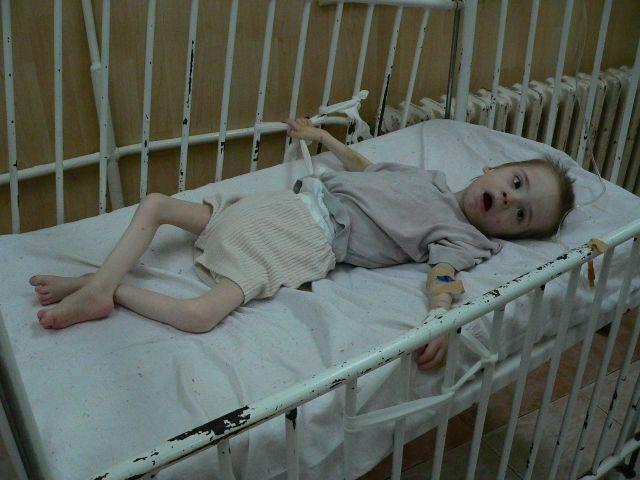
Eastern Europe - Investigators found this emaciated child, tied to her crib, alone in a dark room. An all-too-common practice – children live in their cribs and die in their cribs.
The American Association of Persons with Disabilities conferred on DRI’s founder its highest recognition, the Henry A Betts Award for “pioneering the field of international human rights advocacy and bringing unprecedented international attention to their concerns.”
DRI uses investigative reports to conduct media campaigns and that bring global attention to the concerns of children and adults with disabilities. Collaborating with partners in country, we build the capacity among disability activists to document conductions and create new advocacy campaigns.