Bridging Communities, Advancing Rights
The Meeting Place is a brief and accessible selection of recent highlights and opinions, relevant for children with disabilities. Led by Disability Rights International, and in collaboration with the Global Coalition on Deinstitutionalization (GC-DI) and Lumos Foundation, the initiative works to bring together the disability rights and children’s rights communities to share learning, build collaboration and advance the rights of all children.
GET INVOLVED
Do you work with children and young people with disabilities, support youth-led advocacy or involve young people in care reform?
We would love to hear about your experience. Share examples of meaningful participation, approaches that have helped remove barriers, and lessons about what happens when young people influence decisions.
We particularly welcome contributions that bring forward the perspectives of children and young people with disabilities whose voices are too often overlooked.
You can help us advance disability inclusion by:
- Sharing testimonies - contribute personal experiences or examples that highlight barriers, progress, or lived realities of children and adults with disabilities
- Sharing this newsletter with your networks - help expand its reach by circulating it among colleagues, organizations, and communities who are engaged in or can support disability rights
- Proposing topics and content - suggest key issues, emerging trends, or specific areas that should be covered to ensure the newsletter remains relevant and impactful.
Help us by completing this form.
IN FOCUS:
Participation as a human right
Systems cannot become genuinely inclusive while the people most affected by them remain on the margins of decision-making. Children and young people with disabilities must be able to shape the laws, policies and practices that determine whether their rights are respected and whether they can grow up included in their families and communities.
Children are not merely the people that systems are designed to protect; they are rights-holders whose experiences and perspectives must help shape those systems. Participation means more than asking for their views. It means removing the barriers that prevent children, including children with disabilities, from influencing the decisions that affect their lives.
The United Nations Convention on the Rights of the Child recognizes every child’s right to express their views clearly in all matters that affect them and to have those views given due weight. The Convention on the Rights of Persons with Disabilities (CRPD) reinforces this right, requiring that children with disabilities receive appropriate assistance to express their views and that their views are given due consideration in accordance with their age and maturity. These provisions are mutually reinforcing. The right to participate belongs to all children and disability must never be used as a reason to deny it.
The CRPD goes further stating the obligation to involve representative organizations of persons with disabilities in matters affecting both children and adults with disabilities. The question is not simply whether they’ve been consulted. It is whether they feel safe to speak, whether their views are taken seriously and whether their participation makes a difference.
Meaningful participation means more than inviting a young person to a meeting or asking a question in a consultation. It means providing accessible information, communication support and the time and space needed to express a view. It means recognizing different ways of communicating and taking children's views seriously - even when they challenge the expectations of adults. It also means recognizing the diversity of experiences by children and young people with disabilities. For children living in institutions, or whose lives are controlled by adults and services, being heard is especially difficult.
ENIL Youth: Young disabled people setting their own agenda
Young people are an important part of the European Network on Independent Living (ENIL).
The ENIL Youth Network, founded in 2012, brings together young disabled and non-disabled people to improve Disability Rights for all. Its network enables young disabled people to identify the issues ENIL should prioritise, develop leadership skills, exchange ideas and represent the organisation at meetings and events. It also seeks to improve young people's representation within ENIL's governance and make the organisation's communications more relevant to them.
But what does being part of the ENIL Youth Network actually mean?
What do we do?
The ENIL Youth Network creates opportunities for young people with disabilities to share experiences, learn together, and take action. Through the Network, you can:
• Meet other young people with disabilities from across Europe.
• Share your experiences, oppinions, ideas, and perspectives.
• Learn about independent living and disability rights.
• Take part in discussions, workshops, projects and international events.
• Develop new skills and become a confident advocate for disability and human rights.
• Help shape ENIL's work and priorities.
How can you become a member?
Becoming a member is free for all young people ages 18-35. If you live in Europe and you are disabled, you can become a full member. If you are not disabled, or if you live outside of Europe, you can become an associated member. All kinds of members can join our activities. Whether you are already active or just getting started, your voice matters and there is space for you!
To learn more, click here. To join ENIL and the ENIL Youth Network, you can click here.
Children with Disabilities Lead the Fight for Political Participation in the Republic of Georgia
When the UN Committee on the Rights of Persons with Disabilities (CRPD Committee) adopted General Comment No. 11 on the participation of persons with disabilities in political and public life on 27 August 2026, Validity Foundation and its Georgian partner, Partnership for Human Rights, had already been litigating the political participation of children with disabilities for several months.
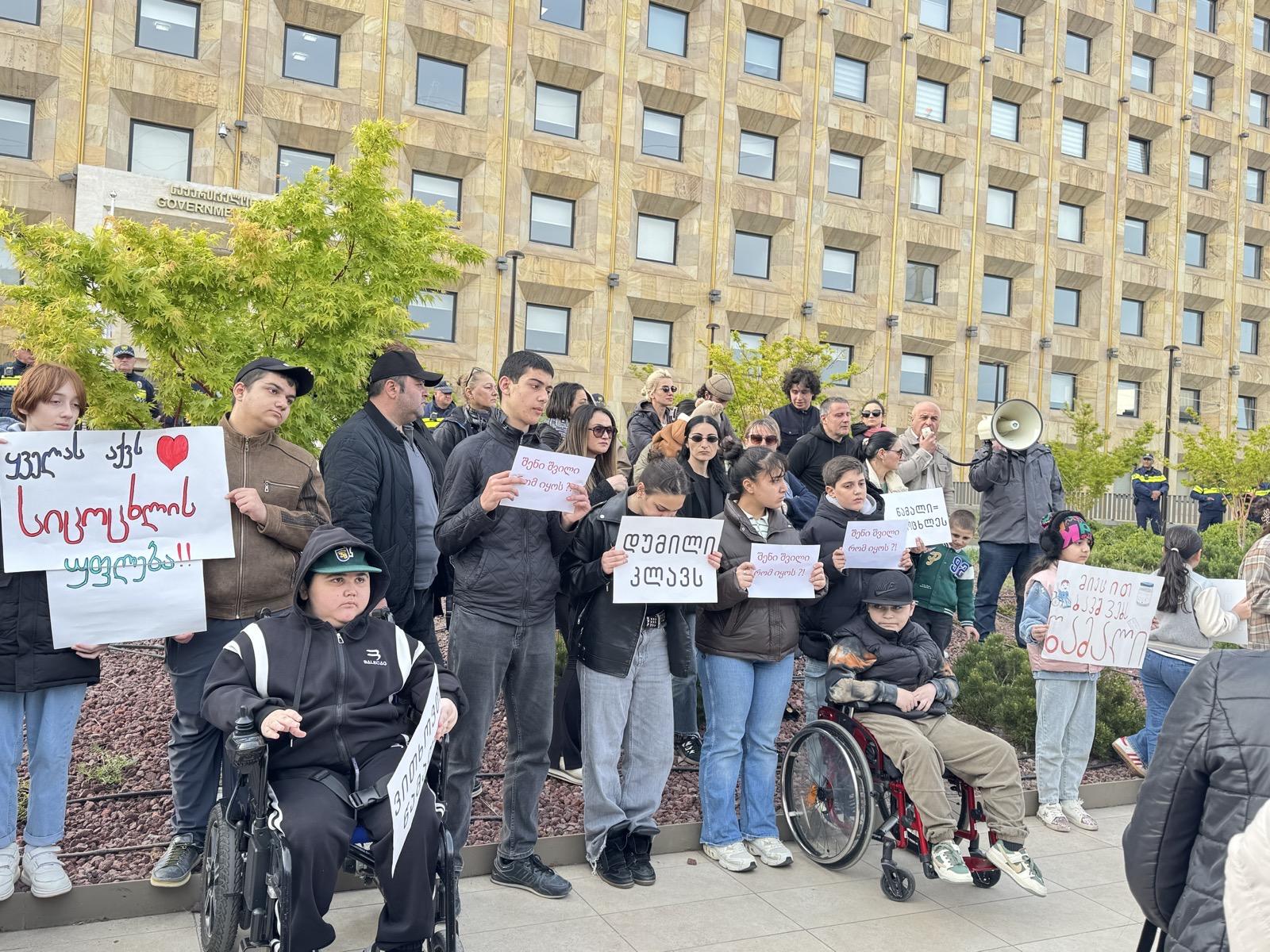
In March 2026, children and adults with Duchenne muscular dystrophy (DMD) began a non-stop protest outside the Government Administration in Tbilisi to demand essential medicines and services. Few could have imagined that children aged 11 to 17 and young people with DMD would not only join the demonstrations but lead them. They called on the Government to fulfil its obligations under the CRPD and to secure a dignified life. For them, that meant access to medication, but also access to schools, rehabilitation and respectful language.
Validity and PHR informed the children of their rights. They also requested that the Ministry of Internal Affairs make the protest accessible: ensure the children’s safety, provide access to cold and hot water and warmth, and allow them to stay with their parents for sufficient periods to communicate and interact. This mattered because the parents stayed overnight but were not allowed to put up tents or any other temporary structures. These needs should have been met not only by the police but also by Tbilisi City Hall.
The authorities did not meet the request, and Validity & Partnership for Human Rights launched the legal action, hoewever the Public Defender (Ombudsperson) of Georgia swiftly granted the request and issued a recommendation stating: “The peaceful assembly held by children with Duchenne and their parents constitutes not only the exercise of freedom of expression, but also the exercise of the right of persons with disabilities and their representative organisations to participate in public and political life. Accordingly, the State is obliged to create conditions that enable persons with disabilities and their representatives to enjoy their rights in a real and effective manner.”
On 4 June 2026, the children and their parents won their fight: every demand raised by the protest was met.
Validity Foundation is now expanding the scope of this work and testing the right to public and political participation in other contexts, examining what conditions the State must guarantee when children with disabilities, placed in State institutions contrary to the Convention, decide to exercise their right to peaceful protest, bearing in mind the many forms a protest can take.
Young People Shaping Care Reform: From Consultation to Influence
What changes when young people with lived experience of care are involved in shaping the decisions that affect them?
The Global Children and Young People’s Taskforce, established as part of the Global Children’s Care Reform Campaign, offers an example of how young people can contribute to reform at local, national and international levels.
The Taskforce brings together 17 young people aged 14–25 from 13 countries, all with lived experience of care systems and 41% of whom have a disclosed disability
Members meet regularly to advise on the direction of the Campaign and develop their own advocacy initiatives. Their contributions demonstrate that young people can do much more than share their experiences. A member from Malawi contributed to a 10-Point Plan for Change developed with Restless Development, identifying issues young people want world leaders to prioritise. A member from Ukraine spoke at a parliamentary meeting with senior political representatives, while a member from Brazil travelled to Brasília with his advocacy group to meet ministers and discuss support for young people leaving care. Most recently, the full Task Force met online with the UK Minister of State for International Development to update her on their work, and outline their priorities.
“It really has been a privilege to work with the Children and Young People’s Taskforce for the Global Care Reform campaign, which is the first time the UK FCDO has created and supported a participatory structure for a foreign policy initiative.
Meeting Minister McNeill is a big moment in that journey and a very tangible example of how we can embed lived experience into policy and the structures that inform decision making. As with every big moment, it is a culmination of so many little wins along the way: Seeing the Taskforce members grow in confidence across this year, form bonds and learn from each other, and take up spaces and opportunities in their context and with issues that matter to them. The Taskforce for me is also a testimony to both the power of collaboration between organisations in this space (this work simply could not be done without the brilliant supporting organisations!) and of participation beyond a right, but enacted as a governance principle and as a transformative process in itself.
I hope that the visibility of the big wins, and the collective power of the little wins for the Taskforce members, can help to move the dial for organisations working with children and young people with disabilities from ‘how will we do this?’ to ‘why are we not doing this?’.” - Lucy Rolington, Senior Policy and Advocacy Advisor, Lumos (Co-Lead of the Taskforce).
These experiences illustrate different ways young people can influence public debate and decision-making when opportunities are created for their participation.
KEY UPDATES:
Children’s Voices and Disability Rights Feature at ACERWC Session
From 13 to 20 October 2026, the African Committee of Experts on the Rights and Welfare of the Child (ACERWC) held its 48th Ordinary Session in Maseru, Lesotho. The gathering brought together Committee members, experts, government delegates from 21 countries, national human rights institutions, civil society organisations, United Nations and African Union partners. Importantly, children were in the room too: ten child representatives took part, and young voices from Lesotho and Angola spoke at the opening ceremony.
For children with disabilities, one of the most significant moments was the Committee’s consideration of a draft General Comment on Article 13 of the African Children’s Charter, which focuses on the rights of children with disabilities. The Committee also adopted a new guidance note on the designation of national focal points within governments to support the implementation of ACERWC’s decisions and recommendations. The Committee proposed the 2027 Day of the African Child theme: “An Integrated Africa for Every Child: Advancing Safe Mobility, Inclusion and the Realisation of Children’s Rights.” The next session will take place from 14 to 24 April 2027.
Citizen Data Project: Investigate, Document and Challenge Institutionalization of Children and Adults with Disabilities
Part 1: Strategic Considerations for Effective Investigations was held on September 10, 2026
The webinar is a part of a training by Disability Rights International to engage civil society in monitoring and advocacy. Supported by International Disability Alliance (IDA) & Lumos Foundation
View or download the slides (English)
Global Coalition on Deinstitutionalization: Thematic workshops on the Guidelines on Deinstitutionalization, including in Emergencies
Part II: International Cooperation and Deinstitutionalization
October 8, 2026
During 2024 and 2025, the Global Coalition on Deinstitutionalization (GCDI) conducted a webinar series titled ‘From Words to Practice’ aiming to unpack the various chapters of the UN Guidelines on Deinstitutionalization, including in emergencies. As part of the webinar series, we organized a thematic workshop focusing on international cooperation.
While the first webinar on this topic focused largely on the voices of persons with disabilities and organizations of persons with disabilities (OPD perspectives), the second webinar “Part II: International Cooperation and Deinstitutionalization” was centering the voices and perspectives of other key stakeholders, such as regional disability forums, government representatives, as well as organizations which work on providing community-based support services for persons with disabilities.
UPCOMING EVENTS & OPPORTUNITIES:
Volunteering in OPDs through the European Solidarity Corps
The European Network on Independent Living - ENIL is thrilled to announce the launch of the new guide: “European Solidarity Corps at the European Network on Independent Living”. The guide was written by Anna Decandia, a 25-year-old young disabled woman from Northern Italy who was an ESC volunteer at ENIL from May to October 2026.
If you are between 18 and 30 years old, come from an EU or associated country, identify as disabled, and are willing to move to Belgium, you should definitely consider applying.
The European Solidarity Corps (ESC) is a European Union youth volunteering program, a part of Erasmus+, that allows young people aged 18 to 30 to volunteer individually or in teams across Europe for a non-profit cause.
As a Europe-wide cross-disability network of disabled people, Independent Living organisations, and non-disabled allies promoting the right of all disabled people to Independent Living, the European Network on Independent Living - ENIL is one of the few organisations that specifically focuses on welcoming disabled ESC volunteers, each year hosting two young people at its Secretariat in Brussels for six months.
The guide aims to be a practical tool both for people interested in applying and for candidates who are selected for the program. It can also be a useful tool for other organisations thinking about hosting young disabled volunteers. It is written from first-hand experience and provides information about:
The volunteer profile ENIL is looking for
The selection process
Working life and potential tasks
Administrative paperwork and trainings
Financial aspects and covered expenses
Advice on arranging and managing Personal Assistance
How to become a member of ENIL and ENIL Youth
Living in Brussels and using accessible public transport
Travel tips and useful websites and apps
A personal story from Anna, ENIL's 2026 ESC volunteer
You can read the guide here.
If you are between 18 and 30 years old, come from an EU or associated country, identify as disabled, and are willing to move to Belgium, you should definitely consider applying. The ESC at ENIL provides young people with a work experience and an experience of living independently in Brussels. For many people, it is the first opportunity to live without their parents and to have Personal Assistance (usually because it is not available in their country or they were supported by their parents). Most people stay involved in the ENIL Youth Network after their experience, some work for OPDs (including ENIL) or other NGOs, others go on to further studies or other work places – including working for the European Union.
ENIL Youth Cafés: Creating space to speak and connect
Whether you're already a member or not, you can take part in a few upcoming ENIL Youth Network activities. You do not need previous experience. All of these are online on Zoom, and they are free.
Register for upcoming events:
"ENIL Youth Cafe: The Right to a Good Time!“
A conversation about disabled people’s right to participate in leisure, sport, culture and recreation.
When: Wednesday, 18 November, 15.00-16.30 CET
To join, register here.
"The Social Rights Gap: Exploring the Spaces between Youth, Disability and Access to Rights”
An interactive panel about how being young and disabled affects our access to education, work, housing, healthcare, and opportunities to participate.
When: Monday, 23 November, 10.00-12.00 CET
To join, register here.
“Youth, Disability and Resistance: Provoking change through research and activism”
A film screening, book discussion, and conversation with Independent Living researcher Miro Griffiths.
When: Second week of December, exact date TBC
To join, register here.
RELEVANT RESOURCES:
Don't Call Me Resilient: Inclusion International Launches Global Report on Care and Support
On 29 October, marking the fourth International Day of Care and Support, Inclusion International, the global network of persons with intellectual disabilities and their families, hosted a webinar to launch a global report Don't Call Me Resilient: How Care and Support Systems Are Failing People with Intellectual Disabilities and their Families.
Around the world, people with intellectual disabilities are being left behind by care and support systems, leaving their families to fill the gaps.
The report documents the experiences of people with intellectual disabilities and their families as they navigate care and support systems around the world, as well as their calls for change. Informed by focus groups and survey data from 42 countries, alongside case studies from Inclusion International member organisations, it reveals how families, in particular mothers, are carrying an unsustainable share of care and support responsibilities.
Formal services are often fragmented, inaccessible, under-resourced, or rooted in outdated, segregated models. As a result, families face burnout and isolation, while people with intellectual disabilities may be pushed towards institutionalisation.
The report's title reflects a powerful message from a mother in Canada: “I hate being called resilient – because if the supports were in place I wouldn’t need to be called that.”
Resilience should never be a substitute for rights. People with intellectual disabilities and their families should not have to compensate for systems that fail to provide the support they need.
The report also highlights a reality that is often unrecognised: people with intellectual disabilities may both receive care and provide it themselves. This is particularly important when considering children and teenagers who take on caring responsibilities within their families. As one sibling shared during the webinar:
“Looking back, I think it is important to recognise that children and teenagers can become carers without ever being identified as such, meaning their own needs, experiences and right to support can easily be overlooked.”
Recognising these young carers is essential to ensuring that their own rights, well-being and need for support are not overlooked.
During the webinar, people with intellectual disabilities and family members—including parents and siblings from across the world—shared their experiences of navigating care and support systems. Speakers from South Korea, Kenya, Ireland, the United States, Colombia, Indonesia, Tanzania, England and other countries brought the report's findings to life. As one parent reflected, “reading the report is a bit like reading the story of our lives.”
But the report is also a call to action. Don't Call Me Resilient sets out recommendations for care and support systems that are affordable, adequately resourced, community-based, and grounded in choice, autonomy, and the leadership of self-advocates and families. It calls for a whole-family approach that recognises care and support as a shared responsibility, rather than a responsibility placed primarily on families.
Care and support must uphold rights, enable inclusion, and recognise the needs of every family member—including children and young people whose caring responsibilities might otherwise remain invisible.
General Comment on article 29 of the Convention on the Rights of Persons with Disabilities (right of persons with disabilities to participation in political and public life)
The General Comment explores how people with disabilities, including children and young peple, can exercise their political rights and take part in public decision-making.
Guidelines on identifying and addressing intersectional discrimination against women and girls with disabilities
These guidelines are relevant to understanding how disability and gender can combine to create distinct barriers, including barriers to participation, that must be recognised and addressed.
Guidelines on identifying and addressing disability-based violence
The Guidelines highlighting the need to identify and address violence and abuse that can silence children with disabilities or prevent them from safely expressing their views.
ABOUT COLLABORATORS
This newsletter is published by Disability Rights International with support from Lumos Foundation.
Disability Rights International (DRI) is a human rights advocacy organization dedicated to the protection and full community inclusion of children and adults with disabilities worldwide. DRI’s Worldwide Campaign to End the Institutionalization of Children is dedicated to promoting the recognition and enforcement of the right of all children to live and grow up with a family and not in any form of institution, orphanage, or group home. DRI is one of the founding members of the Global Coalition on Deinstitutionalization.
Lumos Foundation is an international non-governmental organisation working to realise every child’s right to grow up in a safe and loving family by transforming care systems around the world. Lumos works with governments, civil society, and international organisations to shift away from orphanages and other forms of institutional care towards family-based care and community-based services.
The Meeting Place provides brief and accessible selection of recent highlights and opinions, relevant for children with disabilities.
Led by Disability Rights International, and in collaboration with the Global Coalition on Deinstitutionalization (GC-DI) and Lumos Foundation, The Disability Rights Initiative for Children works to bring together the disability and child rights communities — creating a true meeting place for collaboration, shared learning, and coordinated action.