Left Behind in the War: Dangers Facing Children with Disabilities In Ukraine’s Orphanages

In late April 2022, Disability Rights International (DRI) brought a team of people with disabilities and family activists, including medical and disability service experts, to visit Ukraine’s institutions for children with disabilities.  DRI visited three facilities for children aged six to adult, and one “baby” home for children from birth to age six.  DRI finds that Ukraine’s children with disabilities with the greatest support needs are living in atrocious conditions – entirely overlooked by major international relief agencies and receiving little support from abroad.  

Residential Care Controversy: The Promise of the UN Convention on the Rights of Persons with Disabilities to Protect All Children

Conflicting interpretations of the Convention on the Rights of the Child (CRC) and Convention on the Rights of Persons with Disabilities (CRPD) send mixed messages on the safety and legitimacy of residential care, resulting in the replacement of large institutions with smaller ones often called ‘residential care’ or ‘group homes.’ This article demonstrates how the family inclusion mandate of General Comment No. 5 is rooted in the ‘human rights model of disability,’ fundamental to equal protection under the CRPD for all children with actual or perceived disabilities. The article proposes solutions to ensure full implementation of both the CRC and CRPD.

Still at Risk - Death and Disappearance of Survivors of the Fire at Hogar Seguro Virgen de la Asunción

On March 7, 2017, a group of girls, boys and teenagers protested the physical and sexual abuse, rape and trafficking that they were subjected to at the institution Hogar Seguro Virgen de la Asuncion (Virgen de la Asuncion), in Guatemala City, Guatemala. Virgen de la Asuncion was a public institution where up to 800 children were detained prior to these protests. The authorities of Virgen de la Asuncion called on the National Police to repress the protests. As a punishment, the girls who had protested were beaten and locked up in a tiny auditorium with a capacity for 26 people standing, without a bathroom and access to water, where they were left to spend the night.

Call to action: Protect the right to family life & prevent institutionalization for all children

This call to action seeks to contribute to a range of efforts worldwide to promote consistent interpretation and enforcement of international human rights law in respect of children with disabilities, including the activities of the committees mentioned and other stakeholders and in particular the preparations for a Day of General Discussion on Children’s Rights and Alternative Care scheduled to take place in September 2021 under the auspices of the Committee on the Rights the Child.

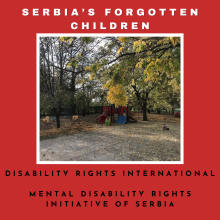
Serbia’s Forgotten Children

This report, Forgotten Children of Serbia, is based on findings of investigations conducted from 2019 to the present by DRI and the Mental Disability Rights Initiative of Serbia (MDRI-S) and, focusing especially on children, shows that these human rights concerns have been permitted to continue. The Serbian government has been put on notice about the atrocious conditions, abuse, and torture taking place in its facilities through years of advocacy by DRI, MDRI-S, and other allies and has failed to take action or hold abusers accountable.

Joint contribution of disability rights organisations to the 2021 EU-Ukraine Human Rights Dialogue

This submission focuses on the situation of children in institutions and the status of the deinstitutionalisation process in Ukraine. Disability Rights International (DRI), European Network on Independent Living (ENIL) and Validity Foundation commend the commitment of European Union to promote the fundamental rights for persons with disabilities and in particular its commitment to deinstitutionalisation of children globally.

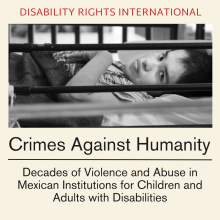
Crimes Against Humanity: Decades of Violence and Abuse in Mexican Institutions for Children and Adults with Disabilities

Children and adults with disabilities throughout Mexico are confined to institutions, segregated from society, and exposed to these dangers – because of the country’s failure to create social supports that would allow people to lead a full life in the community. Mexico’s law strips people with disabilities of the right to make decisions about their own lives – leaving them unable to file complaints or demand accountability when they are abused.

Urgent Appeal to UN Special Rapporteur on Disability

Disability Rights International and the Colectivo Vida Independiente de Guatemala appeal to request immediate life-saving protections for people detained at the National Mental Health facility “Federico Mora” (Federico Mora) in Guatemala City, Guatemala. People with disabilities detained at the “Federico Mora” face an imminent risk of sickness and death as a result of the authorities’ reckless exposure of detainees to the spread of the virus COVID-19, the failure to provide medical care, and their continued unlawful and unnecessary detention in the facility.